
Who invented the traffic light? The earliest road traffic signal is credited to British railway engineer John Peake Knight, whose design was installed outside the Houses of Parliament in London in December 1868. However, it was very different from the electrically powered red, amber and green traffic lights used on roads around the world today.
The invention was not the work of one person alone. Several engineers, police officers and inventors contributed to its development over decades, transforming a manually operated gas-lit signal into the modern systems that regulate traffic and protect pedestrians.
John Peake Knight And The First Traffic Light In 1868
John Peake Knight (1828-1886) was a British railway engineer who recognised that signalling methods already used to control trains could also improve safety on busy roads.
Victorian London’s streets were crowded with pedestrians, horse-drawn carriages, carts and other vehicles. Although motor cars had not yet appeared on its roads, accidents and congestion were already serious problems.
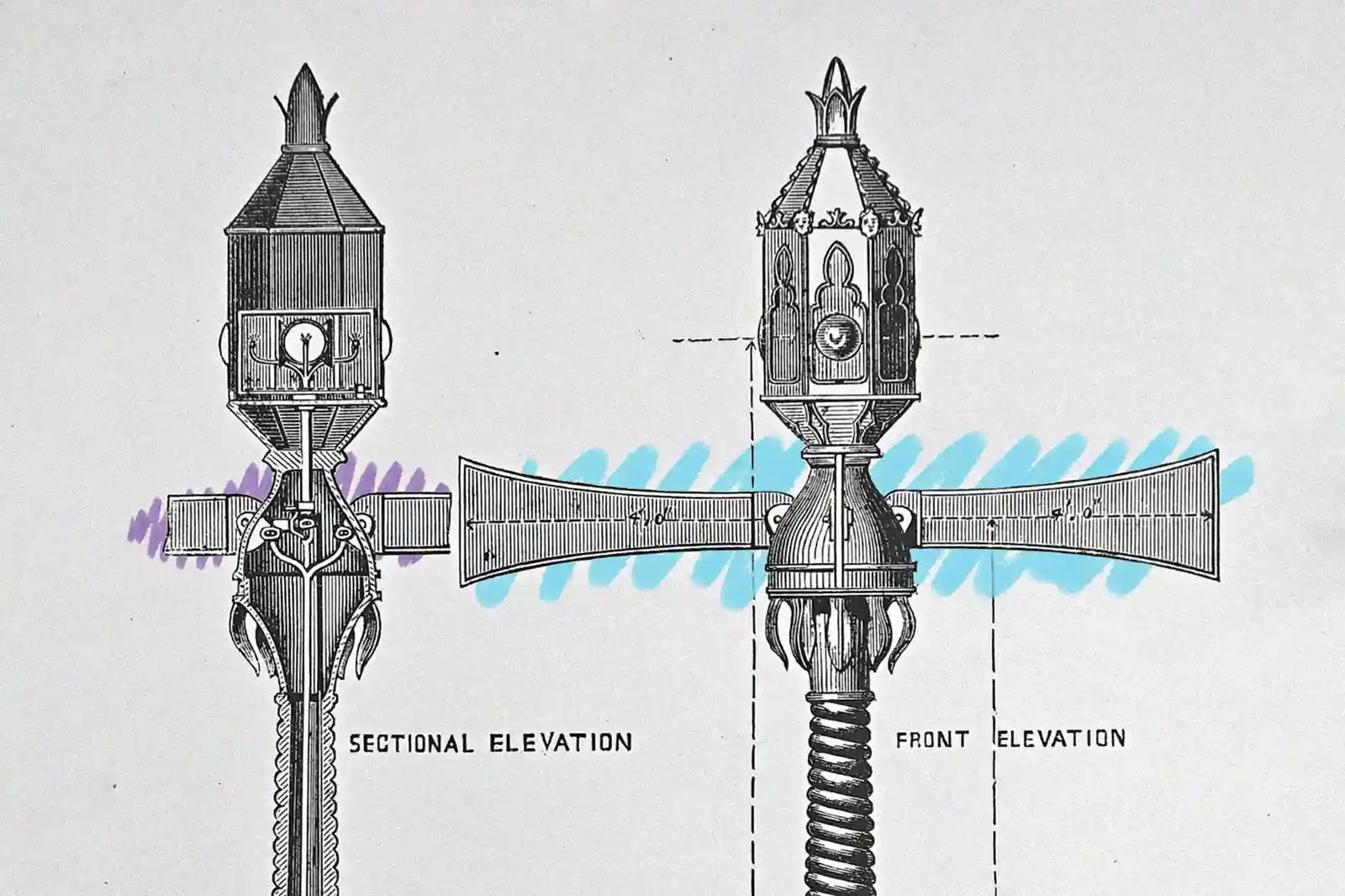
Knight proposed a system that borrowed from railway semaphore signalling. Instead of relying entirely on police officers directing traffic with hand gestures, the system used mechanical arms and coloured lamps to communicate instructions.
The world’s first recognised road traffic signal was installed on Bridge Street, near the Houses of Parliament and Westminster Bridge, in December 1868.
The apparatus stood approximately six metres (20 feet) high and was operated manually by a police constable.
During daylight, movable semaphore arms indicated whether traffic should stop or proceed cautiously. At night, gas-powered lamps displayed red and green lights.
The device was designed primarily to improve safety at a busy crossing, especially for pedestrians attempting to cross roads used by horses and carriages.
It established an important principle: road users could be directed by a standardised visual signalling system rather than depending entirely on the movements and judgement of individual police officers.
Why Did The First Traffic Light Disappear?
Knight’s invention was innovative, but it had a serious weakness: the lighting system depended on gas.
On 2 January 1869, a gas explosion seriously injured a police officer operating the signal. The incident undermined confidence in the apparatus, and the experiment was eventually abandoned.
Although the device had demonstrated the potential benefits of organised traffic control, its mechanical operation and hazardous gas lighting made it unsuitable for widespread adoption.
Electric traffic signals would emerge decades later, as expanding cities and increasing numbers of motor vehicles created a much greater need for reliable traffic management.
Who Invented The Electric Traffic Light?
The development of electric traffic signals involved several American inventors and competing early installations.
Lester Wire And His 1912 Electric Signal
In 1912, Lester Wire, a police officer in Salt Lake City, Utah, developed an early electric traffic signal using red and green lights.
His invention was intended to help officers control increasingly busy intersections more efficiently.
Wire’s design is an important milestone in the history of electrically illuminated road signals, although he did not patent it.
The exact priority of early electric installations is not universally settled, as several American cities experimented with different systems during the same period.
James Hoge And The Cleveland Traffic Signal
James Hoge developed an electric traffic control system that became associated with one of the earliest well-documented installations.
On 5 August 1914, electric traffic signals were introduced at the intersection of East 105th Street and Euclid Avenue in Cleveland, Ohio.
The system used red and green indications, accompanied by written instructions to stop or move. It could be operated by police and helped coordinate the movement of vehicles through the intersection.
The installation also used bells to announce changes in traffic movement. An officer controlled the signals from a sheltered booth equipped with a telephone and fire alarm apparatus. This allowed traffic to be cleared quickly when emergency vehicles needed to pass.
Hoge had applied for a patent in 1913, and his system received US Patent No. 1,251,666 in 1918.
The Cleveland installation is widely recognised as a landmark in the practical adoption of electric traffic signals.
Unlike Knight’s original gas-lit equipment, electric lighting offered a foundation for systems that could eventually become more reliable, automated and interconnected.
William Potts And The First Three-Colour Traffic Light
A major advance came in 1920 when Detroit police officer William L. Potts developed a four-way electric traffic signal using red, amber and green lights. The first installation stood at the intersection of Woodward Avenue and Fort Street in Detroit, Michigan.
An original example of Potts’ signal is preserved in the collection of The Henry Ford museum, providing physical evidence of this important stage in traffic light development.
Earlier signals generally relied on stop and proceed indications. The additional amber, or yellow, light warned that the traffic indication was about to change.
This was a significant safety improvement because motorists needed time to respond before conflicting traffic movements began.
Potts’ design helped establish the familiar three-colour arrangement that would eventually become standard in many countries.
The development was especially important as automobiles became more numerous and intersections grew increasingly difficult to manage.
Modern traffic signals retain the basic three-colour principle, although the precise rules associated with amber lights vary between countries.
Garrett Morgan And The Three-Position Traffic Signal
Garrett Augustus Morgan (1877-1963) was an American inventor and businessman whose work made an important contribution to traffic safety.
Morgan recognised a dangerous weakness in early traffic control: intersections could become hazardous when one direction of traffic received permission to proceed immediately after another was ordered to stop.
He developed a manually operated, three-position traffic signal designed to provide an additional stage between conflicting movements.
The system included a position that stopped traffic in all directions, allowing an intersection to clear before vehicles received permission to proceed.
Morgan applied for a US patent on 27 February 1922. His invention was patented on 20 November 1923 as US Patent No. 1,475,024.
His patented design used a mechanical arrangement with semaphore arms rather than the modern red, amber and green electric lamps.
This distinction matters. Morgan did not invent the original traffic light or the first electric three-colour signal. His contribution was a separately developed, patented three-position system intended to make traffic changes safer.
Morgan’s work illustrates how different inventors approached the same road safety problem using different technologies.
How Did Traffic Lights Become Automated?
Early traffic signals often required police officers or other operators to control them manually.
As traffic increased, relying on an individual at every busy intersection became expensive and impractical. Engineers began developing systems that could change automatically according to predetermined timings.
The first interconnected traffic signal systems also appeared during the early twentieth century, allowing multiple junctions to be controlled together.
Later developments introduced sensors capable of detecting approaching vehicles, allowing signals to respond to traffic conditions rather than follow a fixed schedule.
Automated control eventually developed into more sophisticated networks incorporating vehicle detectors, pedestrian crossing controls and computer-based traffic management.
These improvements made it possible to coordinate signals across major roads and manage traffic movements over much larger areas.
Why Are Traffic Lights Red, Amber And Green?
The colours used in modern traffic lights developed partly from established railway signalling practices.
Railways had already demonstrated the value of communicating instructions through clearly recognisable visual signals.
The three colours became associated with distinct traffic movements:
- Red: Stop.
- Amber or yellow: A warning or transition indication, interpreted according to local traffic laws.
- Green: Permission to proceed when safe and lawful.
However, the meanings were not always identical throughout history.
For example, the green light on Knight’s original 1868 signal indicated caution, rather than the modern general permission to proceed.
The familiar combination gradually became standardised as electric traffic signals spread internationally.
Although the basic colours are recognised in many countries, their sequence, arrangement and legal meanings are not completely uniform worldwide.
Drivers must therefore follow the applicable traffic regulations wherever they are travelling.
How Did Traffic Lights Begin Working Together?
One of the less obvious advances in traffic signal history was the ability to coordinate several intersections rather than control each junction separately.
In 1917, Salt Lake City introduced an interconnected signal system that allowed six intersections to be controlled together from a manually operated system.
This was an important development because changes at one junction could be coordinated with signals elsewhere along a road.
The system was not fully automatic. Human operators still controlled the signals, but the underlying principle of managing several intersections together laid the groundwork for modern traffic control networks.
Who Should Be Credited With Inventing The Traffic Light?
There is no single inventor who can accurately be credited with every stage of traffic light development.
John Peake Knight deserves recognition for the first widely documented road traffic signal, installed in London in 1868.
Lester Wire contributed an early electric design in 1912, while James Hoge’s system helped establish practical electric traffic control in Cleveland in 1914.
William Potts introduced a four-way, three-colour electric signal in Detroit in 1920.
Garrett Morgan subsequently patented an important three-position mechanical traffic signal in 1923.
Together, these developments produced a technology that became fundamental to modern transport.
The history of the traffic light is therefore not simply a story of one invention. It is an example of successive improvements in engineering, public safety and traffic management.
Join The Discussion
Do you think traffic lights have improved road safety and traffic flow, or have modern junctions become unnecessarily complicated?
Share your experiences of unusual signals, historic traffic lights or different traffic systems around the world in the For More Details Forum.
Sources And Further Reading
- Chartered Institution of Highways & Transportation – Traffic Light Anniversary Reached In London – Historical details of John Peake Knight’s first traffic signal in 1868.
- Cleveland Police Museum – Early Electric Traffic Signals In Cleveland – Contemporary accounts of the 1914 electric installation and its operation.
- The Henry Ford – First Tri-Color, Four-Directional Traffic Signal, 1920 – Museum record of William Potts’ original three-colour signal.
- Federal Highway Administration – Garrett Morgan’s Traffic Signal Legacy – Background on Morgan’s invention and contribution to road safety.
- US Patent No. 1,475,024 – Garrett A. Morgan’s Traffic Signal – Original 1923 patent, drawings and technical description.
- Library of Congress – Taking On Traffic: A Closer Look At The Signals – Historical evidence of early traffic signal installations and interconnected systems.
