
How do escalators work? Escalators use an electric motor, a continuous loop of connected steps and a carefully designed track system to move people between different levels. As the motor drives the step chains, wheels follow separate tracks that keep the steps level while they travel along the slope. At the top and bottom, the steps flatten before disappearing beneath the landing and returning through the concealed mechanism.
Escalators are familiar features of shopping centres, railway stations, airports and other busy buildings. They can carry a continuous flow of passengers without requiring everyone to wait for a lift.
Yet the machinery beneath those moving steps is more complex than it first appears. Each visible step forms part of a carefully coordinated system of chains, wheels, tracks, gears, handrails and safety devices.
How An Escalator Works Step By Step
An escalator operates through a continuous mechanical cycle.
- An electric motor supplies power to the drive mechanism.
- The drive system moves chains connected to the escalator steps.
- Wheels attached to the steps follow specially shaped tracks.
- The tracks guide the steps into a staircase along the inclined section.
- At the landing, the tracks bring the steps back into a level arrangement.
- The steps travel beneath the landing and return through the enclosed structure.
- The cycle continues while the escalator operates.
Although passengers see a moving staircase, the steps are actually travelling around a closed loop.
The mechanism allows people to step onto a moving platform, travel between floors and step off onto a stationary landing.
The Main Parts Of An Escalator
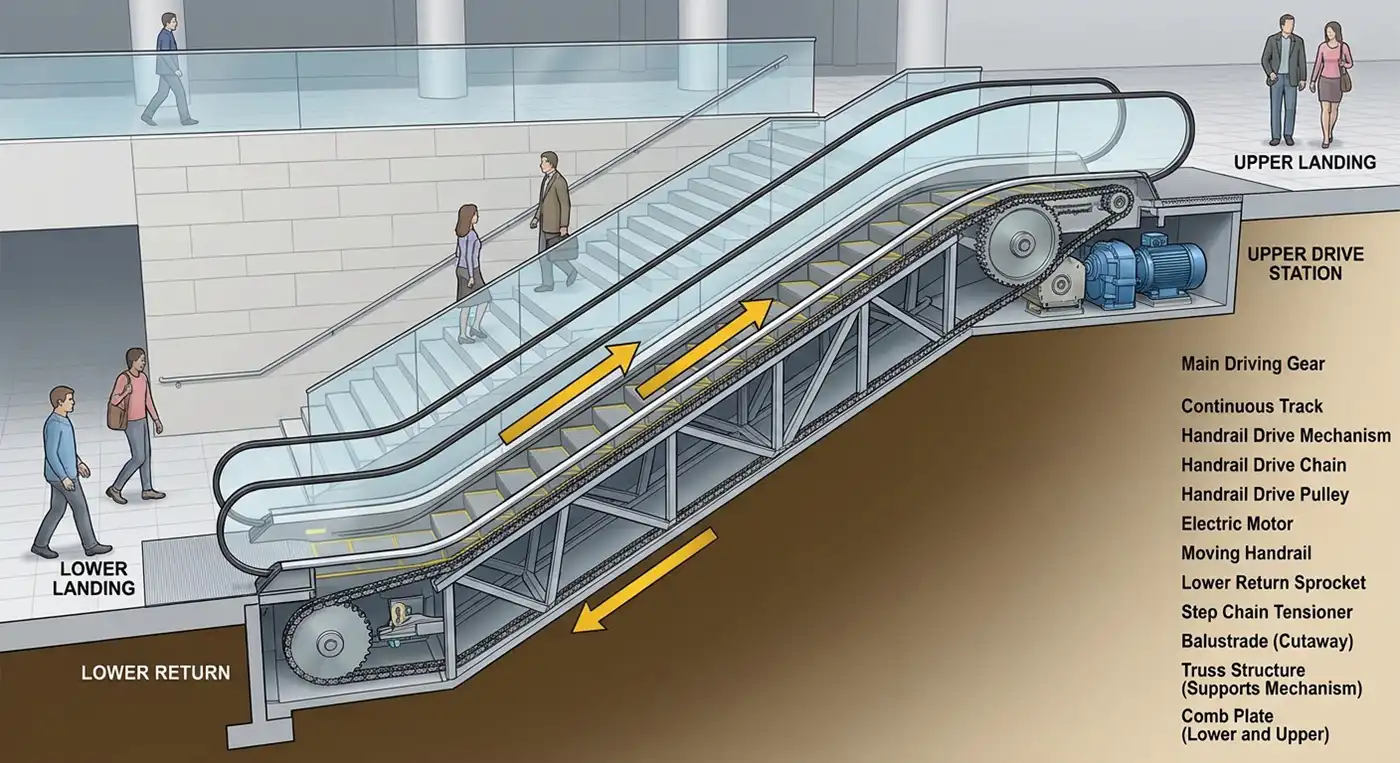
Several mechanical and electrical components work together to make an escalator operate.
The Electric Motor And Drive System
The electric motor supplies the mechanical power needed to move the escalator.
A transmission system, which may include gears, shafts and drive chains, transfers power to the main drive mechanism. Large toothed wheels called sprockets engage with the step chains and move them through the escalator.
The precise arrangement differs between manufacturers and designs.
A controller manages the motor’s operation and works with monitoring and safety devices.
The Step Chains
Escalator steps connect to continuous chains running along the sides of the mechanism.
These chains move the steps together at a controlled rate.
Unlike a conventional staircase, the steps do not remain fixed in one place. Each travels around the entire loop before returning to the visible passenger-carrying section.
The Steps And Their Wheels
Each step has a horizontal tread, where passengers stand, and a riser forming the vertical face between successive steps.
The steps also have wheels or rollers that travel along tracks.
An important detail is that the step assembly uses rollers following different guide paths. The relationship between these tracks determines the orientation of each step.
The steps therefore remain suitable for standing on even though the chains carrying them travel along a slope.
The Truss
The truss is the main structural framework supporting the escalator.
Usually made from steel, it extends between the upper and lower landings and supports the tracks and other mechanical components.
The visible side panels conceal much of this structure.
An escalator is therefore a substantial piece of machinery installed within a building, rather than simply a staircase with moving treads.
How Do Escalator Steps Stay Level?
One of the most interesting features of an escalator is that its steps remain approximately horizontal while moving up or down an incline.
This happens because the wheels attached to each step follow different tracks.
The track geometry controls the relative positions of the rollers, allowing the steps to rise into a staircase along the inclined section.
At the upper and lower ends, the tracks change shape. As they approach the landing, the steps gradually become level with one another.
The steps then pass beneath the landing and travel through the concealed return section.
This arrangement explains why passengers see a staircase on the slope but a series of nearly level moving platforms at the entrance and exit.
Why Do Escalator Steps Flatten At The Ends?
The level sections give passengers a more stable area for stepping on and off.
Rather than immediately entering a steep staircase, passengers can position their feet on a moving step before it begins to rise or descend relative to its neighbours.
At the destination, the steps gradually become level again before reaching the stationary landing.
The number of level steps and the length of the transition area depend on the escalator’s design and applicable requirements.
This is a carefully engineered part of the passenger experience, not merely a consequence of the steps turning around the mechanism.
What Happens To The Steps Underneath An Escalator?
The visible steps are only part of the continuous loop.
After reaching the landing, the steps travel through the turnaround mechanism and return inside the escalator’s structural framework.
In a conventional escalator, this return journey takes place beneath the visible staircase.
The chains and guide tracks continue directing the steps until they reach the opposite landing, where the mechanism brings them back into the passenger-carrying path.
The steps do not detach or stack inside the machine. They remain connected to the moving system throughout their journey.
This continuous circulation is what allows an escalator to operate without repeatedly returning to a starting position in the way a lift does.
How Does The Escalator Handrail Move?
The moving handrail is another coordinated mechanical system.
It usually consists of a flexible, reinforced belt running around the balustrade, which is the structure along the side of the escalator.
A drive mechanism moves the handrail around its own continuous path, with much of the return journey concealed beneath the visible side panels.
The handrail is intended to move at approximately the same speed as the steps so passengers can hold it without their hands being pulled noticeably forwards or backwards.
However, the steps and handrail are not necessarily driven by exactly the same mechanical components.
Wear, incorrect adjustment or faults can cause a mismatch in their movement. Escalators therefore use appropriate monitoring and maintenance arrangements to manage this risk.
If the handrail moves noticeably faster or slower than the steps, passengers should report the problem to the building operator. A significant speed difference may indicate a fault requiring inspection.
Why Do Escalator Steps Have Grooves?
The parallel grooves running along escalator steps serve several purposes.
They provide a patterned walking surface and allow the step treads to mesh with the comb-shaped plates at the landings.
These fixed plates are called comb plates because their teeth project between the grooves of the moving steps.
As the steps reach the landing, the grooves pass through the comb arrangement and continue beneath the stationary floor.
This carefully controlled intersection helps guide the transition between the moving steps and the fixed landing surface.
Why Are Escalator Comb Plates Important?
The comb plate helps form a controlled interface between the moving escalator steps and the stationary landing.
Without this arrangement, the transition could leave a larger opening where items might become trapped.
However, the comb plate does not remove every possible trapping hazard. Loose clothing, footwear and other objects can still create problems near moving components.
Many escalators also have devices designed to detect abnormal movement or obstructions affecting the comb plate.
The exact safeguards depend on the equipment and installation.
What Are The Brushes Along The Sides Of Escalators For?
The brushes fitted alongside some escalator steps are often misunderstood.
They are not primarily intended to clean passengers’ shoes.
Instead, these brush-like components are skirt deflectors.
The skirt is the stationary panel immediately beside the moving steps. The narrow gap between the two creates a potential trapping hazard, particularly if footwear or clothing moves too close to the edge.
Skirt deflectors help discourage contact with this area by creating a noticeable boundary that encourages passengers to keep their feet away from the side panel.
They are one part of the overall protective design and should not be treated as a guarantee against entrapment.
Passengers should keep their feet clear of the sides of the steps rather than deliberately brushing against the deflectors.
How Fast Do Escalators Travel?
Escalators operate at controlled speeds selected for their intended location and passenger demand.
A common nominal speed is approximately 0.5 metres per second.
Some escalator designs use other speeds, depending on their operating environment and the relevant standards.
Busy transport facilities may have different requirements from smaller shopping centres or office buildings.
Speed is not the only factor affecting passenger capacity. Step width, the number of people boarding and the ease of entering and leaving also influence how many passengers an escalator can carry.
An escalator can move people continuously, but it cannot guarantee that every step will be fully occupied.
Do Escalators Run All The Time?
Not necessarily.
Some escalators operate continuously during their normal opening hours. Others use control systems that adjust operation according to passenger demand.
Depending on the equipment, these systems may use sensors to detect approaching passengers and activate the escalator or return it from a reduced-speed mode.
This can reduce unnecessary motor operation and electricity consumption during quiet periods.
The operating strategy must account for passenger safety, the location and the relevant equipment requirements.
An escalator that appears stationary should never be assumed to be safe to use as an ordinary staircase unless its condition and intended use permit it.
Can Escalators Generate Electricity?
Some escalators can recover electrical energy under particular operating conditions.
An escalator carrying a substantial load of passengers downhill may experience a situation in which gravity helps drive the moving system.
Instead of the electric motor supplying all the energy, the mechanical load can drive the motor.
With a suitable regenerative drive, the equipment can convert some of this mechanical energy into electricity and return it to the building’s electrical system.
This does not happen with every escalator.
Regeneration depends on the design of the drive system, passenger loading, direction of travel and operating conditions.
The amount of electricity recovered also varies. Energy must still be used to overcome mechanical friction and other losses.
Nevertheless, regenerative technology demonstrates how a familiar transport system can sometimes recover energy rather than simply consuming it.
How Do Escalators Stop Safely?
Escalators include braking and monitoring arrangements intended to control movement and respond to faults.
Under normal operating conditions, the control system manages starting, running and stopping.
Depending on the design, safety devices may monitor aspects such as:
- Motor and drive operation.
- Excessive speed or unintended reversal.
- Handrail movement.
- Step chains and step positions.
- Obstructions near comb plates.
- Potential trapping at moving components.
- Emergency stop controls.
Some faults cause the safety system to stop the escalator and prevent further operation until the problem has been investigated.
Stopping an escalator is not always equivalent to turning off an ordinary electrical appliance. Its braking system must manage the movement of a mechanical structure carrying people.
For this reason, maintenance, inspection and repair require appropriately competent personnel.
What Does The Emergency Stop Button Do?
Emergency stop controls allow a person to stop an escalator when a dangerous situation arises.
They are generally located near the landings, with additional arrangements where required.
Their purpose is to interrupt dangerous operation, not to provide a routine method for leaving the escalator.
A sudden stop can itself cause passengers to lose their balance, so emergency controls should only be used when necessary.
Anyone encountering a malfunctioning escalator should notify the responsible building operator rather than attempting to restart or repair it.
Why Are Escalators Different From Moving Walkways?
Escalators and moving walkways share some technologies, including motors, tracks, drive systems, handrails and safety controls.
However, they serve different purposes.
An escalator uses individual steps that form a staircase along an incline, carrying passengers between levels.
A moving walkway, sometimes called a travelator, generally uses a continuous belt or a series of connected pallets to carry passengers along a level or gently inclined route.
Moving walkways are especially useful in airports and large buildings where passengers need to travel considerable distances.
Some inclined moving walkways also accommodate appropriate shopping trolleys, subject to the design of the equipment.
The most important distinction is that a moving walkway does not form a conventional moving staircase.
Escalator Safety And Accessibility
Escalators make travel between floors convenient, but they are not suitable for every passenger or every type of equipment.
Passengers should follow the safety signs and instructions displayed at the installation.
Common precautions include holding the handrail, keeping feet away from the step edges, supervising children and taking care when stepping on or off.
Loose shoelaces, trailing clothing and items near moving gaps can present hazards.
Wheelchair users and people who cannot safely board or leave moving steps should use an appropriate accessible alternative, such as a lift.
Pushchairs and similar wheeled equipment should also be kept off ordinary passenger escalators unless the installation specifically permits their use.
In Europe, EN 115-1 addresses the safety of escalator and moving-walk construction and installation. International safety requirements also exist, including ISO 8103-1. Applicable requirements depend on the location and type of installation.
Safety depends on proper design, installation, inspection and maintenance as well as passenger behaviour.
Frequently Asked Questions
Are escalators a type of conveyor?
Escalators share the principle of continuous movement with conveyor systems, but their guided steps, passenger controls and safety arrangements distinguish them from ordinary goods conveyors.
Do escalator steps disappear at the top?
The steps pass beneath the landing and travel through the concealed return mechanism. They remain attached to the continuous moving system.
Why do escalators have yellow lines?
High-contrast markings commonly identify the edges of steps and other areas where passengers should take care. Their exact appearance and requirements vary by installation.
Can an escalator suddenly reverse direction?
Escalators incorporate braking and protective systems intended to prevent uncontrolled movement and unintended reversal. Nevertheless, serious mechanical failures are possible, which is why suitable safety devices and regular maintenance matter.
Do escalators and handrails always move at exactly the same speed?
They are designed to move at closely matched speeds, but minor differences can occur. Excessive differences may indicate a problem requiring attention.
Is it safe to walk up a stopped escalator?
A stopped escalator should not automatically be treated as an ordinary staircase. Whether people may use it depends on the installation, its condition and the building operator’s instructions. Damaged or unexpectedly stopped equipment may present hazards.
Understanding The Engineering Behind An Escalator
The apparent simplicity of an escalator conceals a carefully coordinated mechanical system.
An electric motor drives chains that move a continuous series of steps. Separate guide tracks control the positions of those steps so they form a staircase along the incline and flatten at the landings.
Meanwhile, the moving handrail, comb plates, skirt deflectors, brakes and monitoring devices help make the journey practical and safer for passengers.
The most remarkable feature is how these components work together: the steps continually travel around a hidden loop, yet passengers experience a stable platform moving smoothly between floors.
Escalators demonstrate how thoughtful mechanical engineering can turn a complicated arrangement of moving parts into a familiar feature of everyday life.
KONE – Escalator Diaries
KONE’s official feature explains escalator components and includes a video exploring their operation. Watch via KONE’s official website
Sources And Further Reading
- KONE — Escalator Planning Guide. Manufacturer reference covering components, step tracks, operating speeds, landing transitions and installation design.
- Otis — Escalators And Moving Walks. Manufacturer information on escalator construction, protective features and energy recovery.
- Schindler — Escalators. Explains escalator equipment, energy-efficient operation and control technology.
- UK Health and Safety Executive — Passenger Lifts And Escalators. Guidance on operator responsibilities, maintenance and inspection.
- ISO — Escalators And Moving Walks: Safety Requirements. Official information about ISO 8103-1, the international safety standard covering new escalators and moving walkways.
Discuss Escalators
Have you ever wondered what happens to escalator steps when they disappear beneath the floor, or noticed the handrail moving at a slightly different speed?
Share your questions, observations and experiences in the For More Details Forum.
